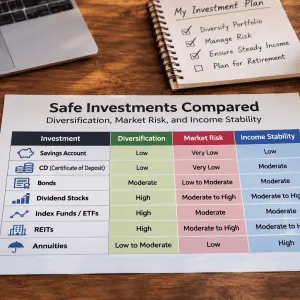
Safe Investments Compared: Diversification, Market Risk, and Income Stability
Nov 28, 2026

Key Takeaways
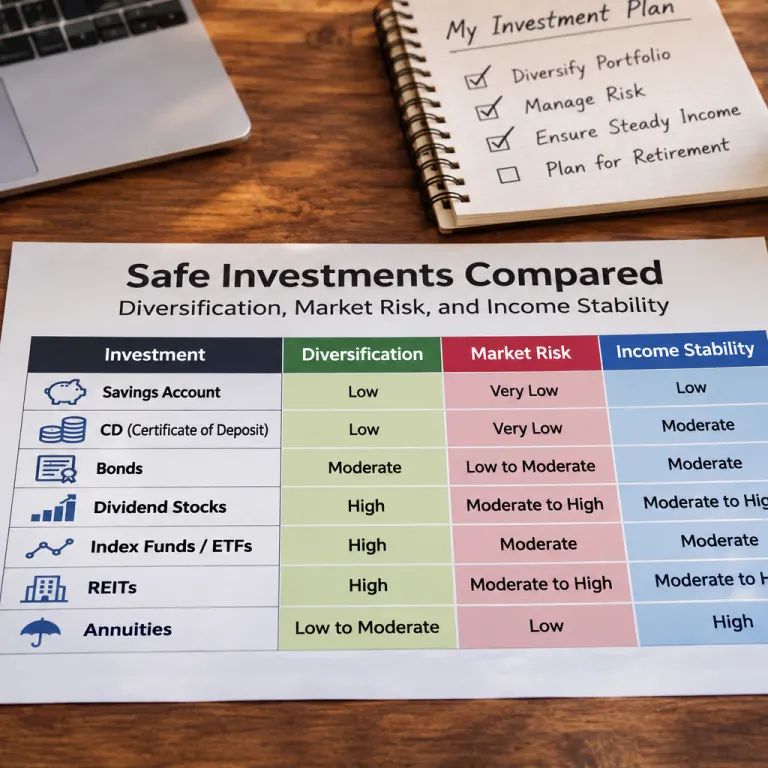
- Diversification helps reduce certain investment risks, but it’s only one part of a comprehensive safety strategy.
- Understanding your risk tolerance is vital to align your investment choices with your comfort level and life goals.
When you’re trying to protect your life savings or plan for retirement, the terms ‘safe investments,’ ‘diversification,’ and ‘income stability’ come up often. But what truly defines a safer investment, and how can you be sure you’re making the right moves to protect your future? This article helps you decode the concepts, risks, and strategies so you can make informed choices and support your long-term financial well-being.
What Are Safe Investments?
Defining safety in investing
Safety in investing typically means protecting the money you’ve worked hard to accumulate. In simple terms, a “safe investment” aims to minimize the risk of major loss to your initial investment (the principal). However, no investment is entirely free from risk—safety is relative, not absolute.
Safe investments often have features such as steady value, reliable income payments, and lower sensitivity to market swings. Financial professionals may call these “principal protection strategies,” which focus on reducing the chance of significant losses over time.
Risk types in secure strategies
Even the most secure strategies involve some level of risk. The main types you might encounter are:
- Market risk: The possibility your investments will lose value due to changes in financial markets.
- Interest rate risk: The risk that changes in overall interest rates could reduce the value of certain investments, like bonds.
- Inflation risk: The danger that rising prices will erode the true value of your returns.
- Liquidity risk: How quickly and easily you can access your funds without significant loss.
- Credit risk: The likelihood that an issuer will be unable to make promised payments.
Understanding these risks is the first step to choosing investments that align with your comfort level and financial goals.
How Does Diversification Reduce Risk?
Why diversification matters
Diversification means spreading your money across several different types of investments, rather than putting all your eggs in one basket. By holding a mix of asset classes—for instance, stocks, bonds, and cash—you potentially reduce the negative impact if one area of the market underperforms.
Diversification helps lower what’s called “unsystematic risk,” or risk unique to a specific company, industry, or investment type. It’s especially useful for anyone seeking safer strategies for their nest egg or retirement savings.
Real-world examples of diversification
Imagine a portfolio that includes:
- U.S. Treasury securities (typically viewed as low risk)
- Municipal bonds (issued by state or local governments)
- Corporate bonds from different industries
- Some high-quality dividend-paying stocks
- Cash or cash-equivalent accounts, like certificates of deposit
This broad approach means losses in one sector are less likely to jeopardize your entire investment plan. Diversification can also provide steady income and stability, even when markets are unpredictable.
What Is Market Risk for Investors?
Understanding market risk
Market risk is the possibility that economic or political events, shifting interest rates, or even global news can cause investments to decline in value. While some investments are less volatile, all are affected in some way by broad market movements.
Market risk cannot be eliminated entirely, even in the safest strategies. You can, however, reduce its overall impact by being thoughtful about your investment mix—this is where diversification and awareness come into play.
Market versus non-market risks
Market risk refers to dangers that arise from broad shifts across the financial marketplace. Non-market risks (“specific” or “unsystematic” risks) relate to issues that affect a single company or sector. For instance, poor management or a discontinued product can affect a company’s stock price, even if the overall market is stable.
Successful investors understand both and take care to use different tools (like diversification) to address each type.
How Stable Is Investment Income?
Sources of stable income
Many people approaching retirement or seeking financial protection prefer investments known for steady payments. Common sources include:
- High-quality bonds, which pay predictable interest
- Government-backed securities with regular payouts
- Certain insured or contract-based solutions
- Some dividend-paying stocks, depending on their consistency and financial health
These instruments tend to deliver income on a regular schedule, which can help with budgeting and confidence in your retirement years.
Factors affecting income consistency
However, stability isn’t guaranteed. Several factors can influence whether your investment income stays consistent:
- Interest rate changes: When general rates rise or fall, bond and deposit yields may shift accordingly.
- Issuer stability: If an organization struggles financially, future payments could be at risk.
- Economic conditions: Economic changes can affect how much income your investments generate, even in typically “safe” categories.
- Inflation: Rising prices can lower the buying power of fixed payments.
It’s wise to review your investments regularly and ensure they still fit your needs and comfort with risk.
Is Diversification Enough for Safety?
Role of risk management
While diversification is a powerful way to lower certain risks, it shouldn’t be your only defense. A comprehensive approach to safety combines several risk management practices, including:
- Setting clear goals and timelines
- Monitoring your investments and adjusting when life changes
- Keeping enough liquidity to cover emergencies
- Continuing to educate yourself or consulting professionals for guidance as laws and markets evolve
These steps help reinforce your financial stability beyond what diversification alone can deliver.
Limitations of diversification alone
Diversification can’t guarantee against all risks, especially those that affect entire markets (systematic risks). During broad downturns, even well-diversified accounts can decline. That’s why it’s important to combine diversification with other strategies—like periodic reviews, risk assessment, and a focus on stable, quality assets.
How Can You Assess Risk Tolerance?
Evaluating your comfort level
Risk tolerance is how much uncertainty or loss you’re willing to accept. Evaluating it involves asking yourself:
- How would you feel if your account value temporarily dropped?
- Do you prefer steady growth with less risk, or are you comfortable taking chances for the possibility of higher returns?
- How close are you to your financial goals or retirement?
Everyone’s risk appetite is unique; understanding yours helps ensure your plan brings peace of mind, not stress.
Aligning strategies with lifestyle
The right safety strategies differ based on your life stage, income needs, and outlook. If you’re close to retirement or relying on investment income, stability and preservation may take priority. If you’re earlier in your journey, you may accept more ups and downs in return for growth potential.
Regular check-ins ensure your investments continue to match both your comfort level and changing circumstances.
Popular posts

Key Takeaways Safe investment strategies can support financial stability when paired with effective compliance practices. Balancing risk and growth is crucial for protecting and preserving retirement assets in a compliant manner.

Key Takeaways Fixed indexed annuities are designed to protect your principal during market downtu…

Key Takeaways Whole life cash value grows gradually through guaranteed mechanisms and long-term policy design, making patience a central part of how it works.Accessing cash value c…
Valuable tools to educate yourself – and thrive.
The Certified Safe Money advantage includes access to valuable resources to help you make the right decisions for your retirement goals – because we believe knowledge is power.Browse our current e-books below and prepare yourself for the future.